Originally from the small French village of Orgeval, Prune Pauchet’s path into modelling and acting is far from straightforward and continues to surprise her.
You might recognize her face from campaigns for Rouje, Sessùn, and Franck Provost, to name a few. From cinema to theatre to fashion, she has gradually carved out a creative world of her own. Comfortable moving between French, English, and Spanish, she’s interested in the possibilities that come with working across cultures in creative disciplines. We spoke to her about the films that shaped her, the challenges of inhabiting unfamiliar characters, and the roles she hopes to explore next.

You recently appeared in Lionel, Carlos Saiz’s independent Spanish-French feature film, which won Best Film at the Atlàntida Mallorca Film Fest. First of all, congratulations! What attracted you to the project, and what was it like working with a team in a different language and cinematic environment?
Thank you! It was truly an experience! I was really drawn to the realism of Carlos’s project. He had this idea of making a fiction film that was very close to documentary, because the main characters aren’t actors. It’s their actual lives. They really are a family, and in the film, they live through their own family story and everything they’re struggling with. So, in a way, it was very intense to be in the middle of that, because I knew they weren’t acting. It’s a very visceral film, and a beautiful one.
You speak French, English, and Spanish. How does moving between different languages influence the way you express yourself, both personally and professionally?
It’s so interesting to learn new languages, to be able to express yourself and connect with people from other places. I think it has opened my mind to new perspectives. Sometimes it helps me step into a story: you suddenly feel like someone far from home, trying to build a new life.
Would you like to pursue more international projects, perhaps working with directors and actors from different countries?
Oh yes! If I could meet a genie and make three wishes, one would definitely be to speak every language in the world. But there’s something beautiful about two people who don’t share a language trying to make themselves understood. I find that very cinematic too. And I definitely need to learn Norwegian, because I love Joachim Trier’s work.
You recently completed filming a Netflix series scheduled for release next May. Without giving too much away, what can you tell us about the experience and the character you play?
I play a child psychologist in a hospital, a 29-year-old mother of two who is trying to find her place between an ex-boyfriend who suddenly wants to be 20 again and the life she still believes in. During filming, I realized just how deeply this role had touched me. As someone who doesn’t have children of my own, I hadn’t fully understood what it meant to be a single mother of two, feeling abandoned by an immature ex-boyfriend and having to be the grown-up because he can’t be.
You also appeared in a short film that was acquired by Canal+ and co-produced by Raphaël Quenard. What was particularly memorable about working on this project?
It was an incredible project. Adrien and Roman are so talented. It was amazing to watch Adam’s apartment come to life. At the beginning, it was an empty space, and they created such a mood. It became our home every day, and we brought it to life. It was the only witness to our love and our breakup.
You work across fashion and cinema, two worlds that are both deeply concerned with image and representation. Fashion imagery often captures a very specific moment, whereas cinema allows a character to develop over time. Which form of storytelling feels more natural to you?
I would say cinema. Fashion often captures a powerful image of people at a particular moment, whereas cinema gives a voice and a powerful image to real life and to real people struggling with life’s problems. Maybe it’s less immediate than fashion, but it’s closer to real life, which can be full of paradoxes.

What first attracted you to acting? Was there a particular film, performance, or experience that made you want to explore it?
I remember feeling very, very alive at the end of certain films when I was little. I would go back to my childhood bedroom full of desire, strength and dreams. But acting had never been an option as a career. My family is far removed from that world. Theatre always came to me as a way of truly expressing myself.
The first thing I acted in was Oscar et la dame rose, based on the novel by Éric-Emmanuel Schmitt about a young boy who is dying of cancer and a woman known as the Pink Lady, who comes to spend time with him every day and bring him some joy. In the end, of course, he teaches her a life lesson.
At some point in my life, I had to choose. I had to try. A friend of mine lost his life in an accident when I was 19, and I suddenly realized that you have to go for what you truly want before it’s too late.
You have worked in both theatre and film. How does the experience of performing live compare with being in front of a camera?
It’s so different. Both can be so magical. I would say that on stage, you give. Everything has to be big and loud so that people can receive it. In front of the camera, you give to your scene partner while also feeling everything for yourself. You’re deeply connected to yourself. The smallest thing can be felt and conveyed through the camera. It’s intimate.
Are there directors or actors whose approach to storytelling you particularly admire?
I could watch Renate Reinsve and Kate Winslet for hours and hours. There is so much passion in their work. They can be completely broken and incredibly strong at the same time.
Whether in fashion or acting, do you tend to gravitate towards certain types of characters, or are you more interested in roles that take you somewhere unfamiliar?
I guess I do have an archetype, but I’m really interested in going places I don’t know.
Is there a particular role you would love to play but haven’t had the opportunity to explore yet?
I would love to embody Joan of Arc, or the mother of Jesus.
Which films have stayed with you long after watching them?
When I was young, I was obsessed with The Beach by Danny Boyle. All the music, and that feeling of being at the end of the best moment of your life. Laurence Anyways by Xavier Dolan has always been very special to me too. It’s about a woman who truly loves her partner and fights to be there for her through her transition, while also fighting to remain the woman she wants to be. More recently, La Gradiva by Marine Atlan really took me somewhere I’m still in.
I read that you are also interested in drawing and writing, and that you directed Dors mon amour. Do you see yourself becoming more involved in filmmaking and directing in the future?
Yes, it’s something I want to make more room for in my life. I’m currently working on something inspired by a musician friend, Devanna, around the theme of breakups.
You have collaborated with brands including Sessùn and Rouje. Is there a particular era, designer, or visual language that you continually find yourself returning to?
I think the simplest is always the best. Blue jeans, a white shirt. When I work, I love being neutral. It’s the starting point for building a character. But I also love embodying different styles.
If you could spend a year exploring a completely different creative discipline, what would it be?
Dance. I would love to perform in Vollmond, one of Pina Bausch’s pieces. Or be a psychologist in a prison.
If you could imagine your career five or ten years from now, what would you like it to look like? Would you prefer to focus on cinema, explore directing, work internationally, or keep moving between different creative worlds?
I would like to have explored a lot of unfamiliar territory through my roles and to see my career grow internationally.

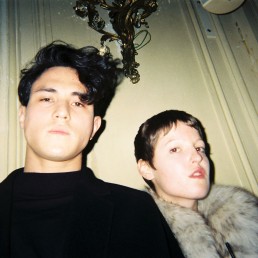
Imagery: stills from La Voleuse